Carex backii
 
Back's Sedge

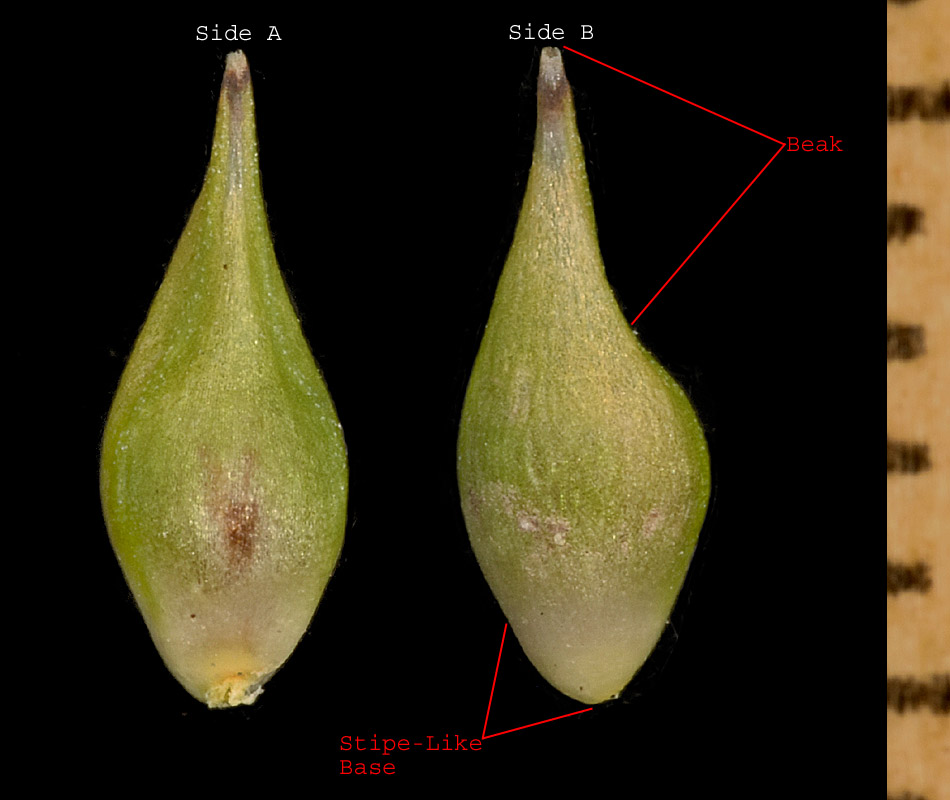
Perigynium - Two Views

Highway Ditch Just Above Nitenai Salt Marsh
29-June-2026

Note the perigynia of this species are 4.8-6.6 mm long and gradually taper into a beak. The perigynia of C. saximontana are 3.2-4.9 mm long and abruptly taper into a beak. Note also the beak of this species is longer than the stipe-like base; the beak is about the same length as the stipe-like base in C. saximontana.

Many thanks to Dustin Snider who found this specimen.

Backii: Answers to key questions in Sedges (Carex) of Saskatchewan, Fascicle 3, Flora of Saskatchewan by Anna Leighton leading to this species. The answers are in the order you would normally work through the key. 
Stigmas 3; achenes three-sided, occasionally terete, though their shape may be concealed by flattened perigynia. NOT [Stigmas 2; achenes lenticular.]
Spikes 2 or more per culm, terminal and lateral; spike bracts present on lateral spikes (except in Section Phyllostachyae), lowest bract usually evident, often conspicuous.  NOT [Spikes 1 per culm, terminal; spikes bracts absent.]
Lower pistillate scales resembling green, leaf-like bracts much longer and wider than individual perigynia.  Section Phyllostachyae. (C. backii, C. saximontana). NOT [Lower pistillate scales not bract-like or leaf-like but similar in size and shape to individual perigynia (up to twice as long as perigynia in C. magellanica ssp. irrigua)]
Perigynia 4.8-6.6 mm long, gradually tapering into a beak 2 mm long or longer; stipe-like base shorter than beak. NOT [Perigynia 3.2-4.9 mm long, abruptly tapering into a beak to 1.2 mm long; stipe-like base about same length as beak.]