|
Stipeae: Answers to key questions
leading to this tribe.
 | Mature inflorescence, if breaking into units, then the units not as
below; NOT [Mature inflorescence breaking into spikelet units consisting
of a sessile fertile spikelet, a hairy pedicel with or without a sterile
spikelet at tip, and a hairy rachis joint, all arising at the same point
(a node) in specialized panicle branches called rames] |
| Spikelets not as below; sterile florets if present, either located
distal to the fertile floret(s) on the rachilla or paired and attached
at the base of a single fertile floret, not paired with the upper glume
as below; lemma and palea variously textured, enclosing the flower or
not; disarticulation usually above the glumes; NOT [Spikelets usually
dorsally compressed, appearing 1-flowered but containing 1 fertile
floret and 1 sterile floret, the latter attached to the base of fertile
floret opposite the upper glume, resembling the upper glume, and
together with the upper glume enveloping the fertile floret; lower
glumes minute (sometimes absent) to 3/4 as long as upper glumes and
typically wrapping most of the way around the pedicel at base; fertile
floret seed-like with chartaceous-indurate lemma and palea enclosing
flower and fruit; disarticulation below the glumes with rare exceptions] |
| Spikelets 1 to many-flowered, subtended by a pair of glumes (only 1 on
lateral spikelets in Lolium); palea margins enclosed or not; plants of
dry or wet habitats; NOT [Spikelets 1-flowered, lacking glumes; margins
of the palea tightly enclosed by the lemma margins on female or perfect
florets; plants of wetlands, often emergent aquatic] |
| Inflorescence not as below; if a terminal spike, then the lateral
spikelets attached edgewise to the rachis with inner (upper) glume
wanting (as in Lolium); NOT [Inflorescence a terminal spike with sessile
or subsessile spikelets attached broadside at nodes on opposite sides of
the rachis] |
| Lemmas stiff to indurate, firmer than the glumes, surrounding the
palea and often overlapping along the margins, closed at the tip as well
as at the base, often pubescent; lemma awns (caducous or wanting in some
species) terete and encircled at the base by the closed tip of the
lemma; calluses usually pubescent, rarely glabrous; NOT [Lemmas and
lemma awns not as above; if lemma indurate and enveloping the floret,
then glumes distinctly dorsally compressed and calluses glabrous (as in
Milium)] |
| Lemma awns 1, persistent or caducous; lemmas usually pubescent; NOT
[Lemma awns 3, persistent; lemma glabrous]
|
|
|
Achnatherum: Answers to key questions
leading to this genus (in tribe Stipeae).
| Lemma awns 1-32+ mm long; lemmas 1.5-7 mm long; callus to 2 mm long,
blunt to pointed but not sharp-tipped; glumes 2.5-13 mm long; NOT [Lemma
awns 50-225 mm long; lemmas 7-25 mm long; callus 2-6 mm long,
sharp-tipped; glumes 15-45 mm long] |
| Basal blades not overwintering, usually rolled and narrow, if flat,
then to 5 mm wide and not twisted at base; cauline blades ?
well-developed, flag leaf blade more than 1 cm long; other features
variable; NOT [Basal blades green late in the season, overwintering,
flat to ? revolute, 4-9 mm wide, tapering at both ends and twisted 180?
at base; cauline blades reduced or obsolete, the flag leaf blade at most
1.2 cm long; glumes green with scarious margins and tip; panicle narrow
with appressed branches; callus blunt, densely pubescent] |
| Lemma apex not forming such a crown; sheaths not villose near throat
but if short tufts of hair present, then collars glabrous; glumes, if
hyaline, then with less conspicuous nerves; glume tips at most
long-attenuate; NOT [Lemma apex forming a straight-sided, ? glabrous crown rimmed with
hairs 0.5-0.75 mm long; sheaths villose near throat; collar pubescent on
basal and lower cauline leaves; glumes hyaline with conspicuous, green
nerves at base; glume tips filiform] |
| Glumes 5.5-12.5 mm long; paleas <= lemmas; if paleas = lemmas, then
lemmas densely, evenly pilose with hairs 2.5-6 mm long and glumes
sac-shaped at base and abruptly narrowing to an acuminate tip; NOT
[Glumes 2.5-6 mm long; paleas >= lemmas]
|
|
Hymenoides: Answers
to key questions leading to this species (in genus Achnatherum)
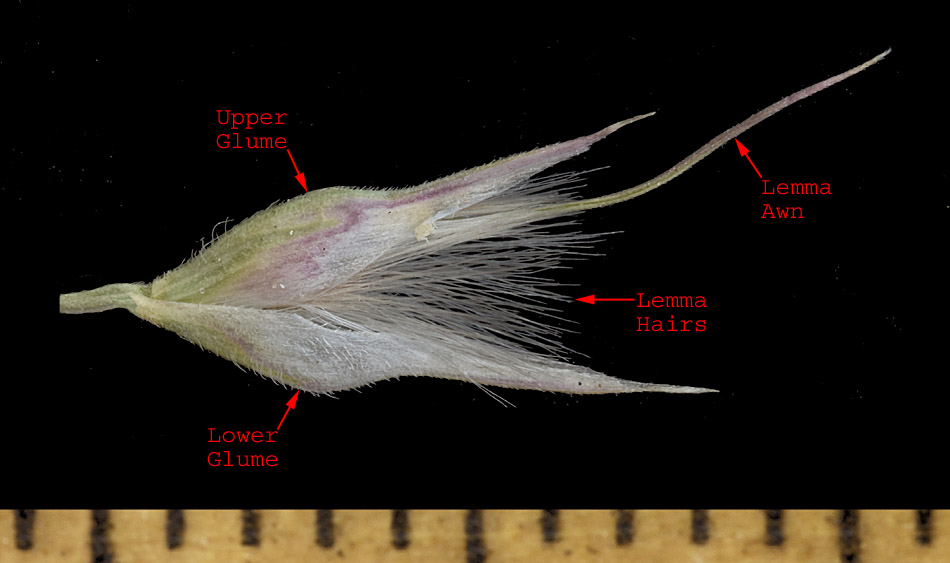
| Glumes papery, sac-shaped at base and abruptly narrowing to a
long-pointed tip; lemmas densely and evenly pilose with hairs 2.5-6 mm
long, the tips of the hairs visible between the glume tips; lemma awns
3-6 mm long, caducous, straight, not twisted at base; paleas glabrous
and about equal to lemmas in length and width; panicles diffuse with
divaricately forked branches, and spikelets solitary at tips of long,
spreading pedicels; NOT [Glumes thinly membranous, hyaline distally,
lanceolate, not sac-shaped at base; lemmas pubescent with hairs 2 mm
long at most and not visible between the glume tips; lemma awns >= 15
mm long, persistent, weekly twice-geniculate, twisted below; paleas
pubescent and at most 2/3 the lemma length and much narrower than the
lemmas; panicles not as above.] |
|
|