|
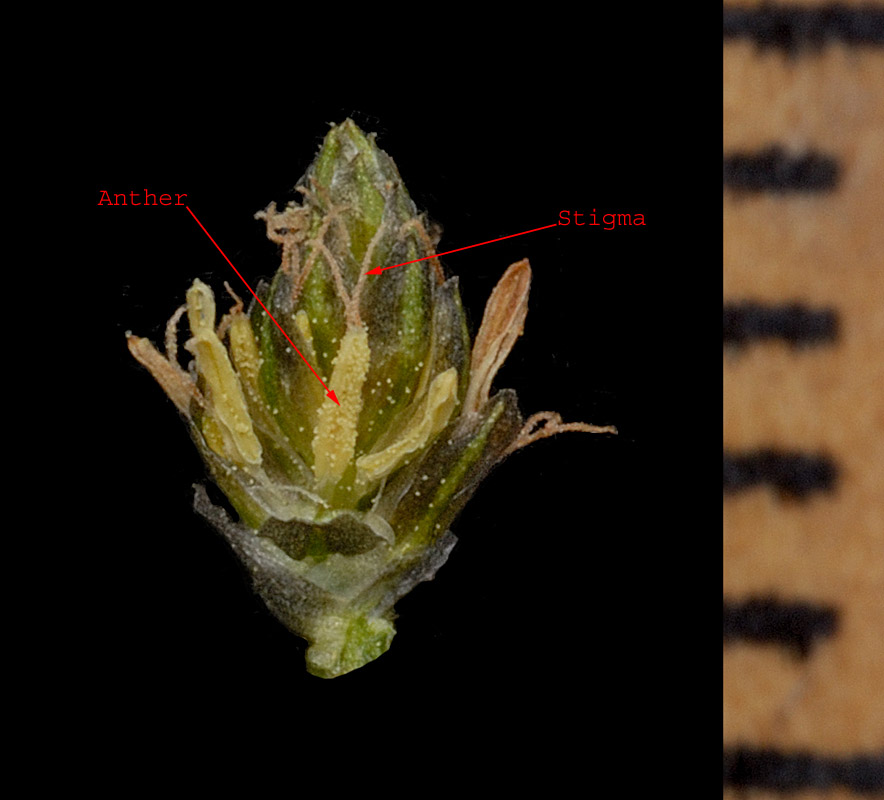
Flowers
and achenes naked in the axils of scales, not enclosed in a sac; flowers
usually perfect (sometimes some flowers imperfect in Cyperus,
Rhynchospora and Cladium). NOT [Flowers and achenes enclosed in a
sac (perigynium) borne in the axils of scales; flowers imperfect.] |
|
Perianth
bristles absent or up to 6 per flower; if more than 6, then only
somewhat longer than the achenes. NOT [Perianth bristles usually
more than 10 per flower, much longer than the achenes, conspicuously
elongated to over 10 mm long in fruit stage and usually obscuring most
scales in spikelets.] |
|
Inflorescence
not a solitary, terminal spike; if solitary, terminal and spike-like,
then inflorescence +/- terete. NOT [Inflorescence a compressed,
solitary, terminal spike bearing few-flowered spikelets attached in 2
rows.] |
|
Inflorescence
usually with > 1 spikelet; if only 1 spikelet present, then
inflorescence bract usually 10 - 200 mm long (but as short as 7 mm in
Schoenoplectus subterminalis) and achenes 2 - 3.5 mm long. NOT
[Inflorescence a solitary terminal spikelet; inflorescence bracts absent
or up to 8 mm long and only slightly longer than the spikelet; achenes
usually <= 2 mm long (up to 2.3 mm in Eleocharis quinqueflora).] |
|
Achenes
lacking a tubercle but sometimes beaked. NOT [Achenes with a
narrowly triangular tubercle.] |
|
Scales of
spikelets spirally arranged; spikelets terete. NOT [Scales of
spikelets 2-ranked; spikelets flattened or 4-sided.] |
|
Plants
without the following combination of characteristics. NOT [Culms
tall and slender, 30 - 100 cm high and 1 - 2 mm wide; inflorescences
with stiffly ascending primary and secondary branches supporting 100 -
1,000 spikelets in compact clusters; achenes terete with bases discoid,
truncate, impressed and flared.] |
|
Inflorescences
subtended by 2 or more leaf-like, erect to spreading bracts; longest
bracts exceeding the inflorescence; leaves basal and cauline, or all
cauline with cauline leaf blades well developed. NOT
[Inflorescences not subtended by leaf-like bracts, the proximal bract
terete, trigonous or thickly C-shaped in cross-section and resembling a
continuation of the culm (making the inflorescence appear to be attached
to the side of the culm although the bract may be pushed aside in
Amphiscirpus as the spikelets mature); longest bracts exceeding the
inflorescence or not; usually all leaves basal with blades often much
shorter than their sheaths.] |
|
Spikelets
numerous (50 - 500 per inflorescence) and small (2 - 8 mm long (ours),
1- 3.5 mm wide); anthers ca. 1 mm long (ours); scales glabrous,
apiculate, mucronate or with awns to 0.6 (1.2) mm long (ours); achenes
0.6 - 1.8 mm long; culms not cormose at base. NOT [Spikelets fewer
(ours < 40 per inflorescence) and large (7 - 40 mm long (ours), (4) 6
- 10 mm wide); anthers 2 - 4+ mm long; scales puberulent to glabrescent
with awns 1 - 3 mm long; achenes 2.3 - 5.5 mm long; culms cormose at
base.]
|