|
Stigmas 3;
achenes three-sided, occasionally terete, though their shape may be
concealed by flattened perigynia. NOT [stigmas 2; achenes
lenticular] |
|
Spikes 2
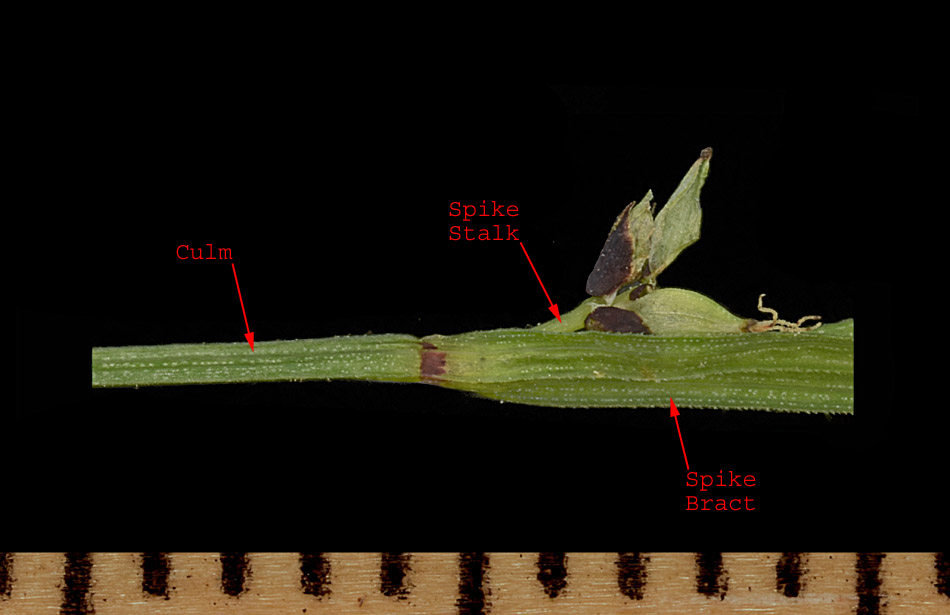
or more per culm, terminal and lateral; spike bracts present on lateral
spikes (except in Section Phyllostachyae), lowest bract usually evident,
often conspicuous. NOT [Spikes 1 per culm, terminal; spike bracts
absent]. |
|
Lower
pistillate scales not bract-like or leaf-like but similar in size and
shape to individual perigynia (up to twice as long as perigynia in C.
magellanica ssp. irrigua). NOT [Lower pistillate scales resembling
green, leaf-like bracts much longer and wider than individual perigynia] |
|
Perigynia
glabrous. NOT [Perigynia sparsely to densely pubescent or puberulent (in
C. pedunculata pubescence represented by very short hairs scattered near
tip; in some species of Sect. Acrocystis, perigynia may be glabrous or
virtually hairless, but all members of this group have convexly 3-sided
to terete achenes with tight fitting perigynia and a stipe-like base
about equal to beak in length)] |
|
Beak
absent or less than 0.5 mm long; if more than 0.5 mm long, then
terminating in an orifice without teeth. NOT [Beak over 0.5 mm long and
usually visibly bidentate (teeth hyaline in C. sprengelii, inconspicuous
in C. viridula, very short in C. oligosperma).] |
|
Leaves and
sheaths glabrous; plants cespitose or rhizomatous. NOT [Leaves and
sheaths pubescent; plants cespitose] |
|
Lowest
spike bracts sheathless or with sheaths 1-2 mm long (to 3 or 4 mm long
in Section Limosae). NOT [Lowest spike bract sheath at least (2.5)
3 mm long] |
|
Plants
cespitose or rhizomatous, usually taller than 2 dm (to 8 dm); terminal
spike if staminate then wider than 2 mm or longer than 1 cm, or
pistillate spikes long-stalked; leaves 1-6 mm wide; plants of boreal
forest and grassland habitats. NOT [Plants densely tufted and low,
usually less than 2 dm tall; terminal spike staminate (occasionally with
a few pistillate flowers at base in C. glacialis), 1-2 mm wide and
seldom over 1 cm long; pistillate spikes sessile or slightly stalked;
leaves 0.4-1.5 mm wide; plants of rocky and/or sandy habitats in far
north.] |
|
Lateral
spikes sessile or erect on short stalks. NOT [Lateral spikes on
filiform stalks 0.5 cm long or longer, often nodding.] |
|
Terminal
spike gynecandrous (various in C. parryana ); if not gynecandrous, then
scales on pistillate spikes completely covering perigynia throughout
spike. NOT [Terminal spike staminate; at least some pistillate
scales shorter and/or narrower than perigynia] |
|
Terminal
spike gynecandrous; perigynia 2.2-4 mm long; pistillate scales not
completely covering perigynia; culms a few together or densely
cespitose; widespread boreal species. NOT [Terminal spike
gynecandrous, staminate, pistillate or staminate with scattered
pistillate flowers; perigynia to 2 (2.5) mm long, shiny; pistillate
scales about same size as perigynia and covering them; culms single or a
few together from distinct rhizomes; plants of marly seeps in southern
half of province.] |
|
Spikes
densely overlapping at tip of culm; pistillate scales awnless, one-half
to three-quarters as long as perigynia; perigynia 2.2-2.5 (3) mm long,
green, smooth or papillose. NOT [Spikes loosely overlapping (lower
often separate); pistillate scales with awns 0.5-3 mm long, the awn tips
or scale tips reaching top of perigynia, or beyond; perigynia 2.6-4 mm
long, pale, dull and densely papillose.] |