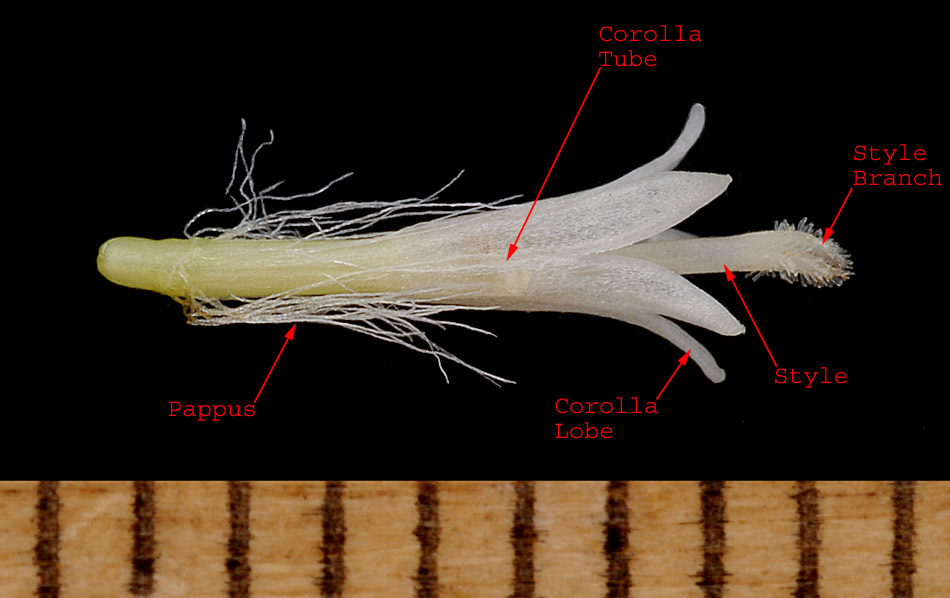
Arrow-Leaved Colt's-Foot
Petasites sagittatus
Arrow-Leaved Colt's-Foot
Staminate Tubular Floret Side
Good Spirit Lake Provincial Park
15-May-2010
This plant is imperfectly dioecious and the flower head morphology is complicated. The following is a summary of the rather dense description in the Flora of North America entry for Petasites.
Staminate flower heads are usually composed of a small number of peripheral ray florets that are either neuter or style-bearing and sterile, and a large number of inner tubular florets that are functionally staminate. (The neuter florets have a reduced, sterile style or no style at all.)
Pistillate flower heads are usually composed of a large number of peripheral ray florets that are functionally pistillate, and a small of number of inner tubular florets that are functionally staminate. In between the two sets there may be a number of intermediate florets that are functionally pistillate and whose corolla ranges from five-lobed to minutely two-lipped to bearing a reduced ligule.
There can be deviations from the above. Ray florets are occasionally missing from both staminate and pistillate heads. The inner tubular florets of staminate heads are occasionally bisexual and fertile. Finally, Flora of the Great Plains states that the peripheral ray florets of staminate heads can be functionally pistillate.
Interestingly, this complicated reproductive morphology varies little between the various putative species recognized by Budd's Flora, Flora of Alberta and this site. Species are therefore differentiated based upon leaf character states. Flora of North America finds that there is intergradation between all these states, and as a result includes all these species as varieties under a single P. frigidus.
Note that one of the paths to Petasites in the Budd's Flora key incorrectly requires florets yellow or greenish yellow; NOT [florets purplish white, purple, or rose]. The rest of the key answers are listed below.
 | Sagittatus: Answers to key questions in Budd's Flora and Flora of Alberta leading to this species.
| ||||||||||||||||||||||||||||||||||||||
| Petasites: Answers to key questions in Budd's Flora and Flora of Alberta leading to this genus.
|
