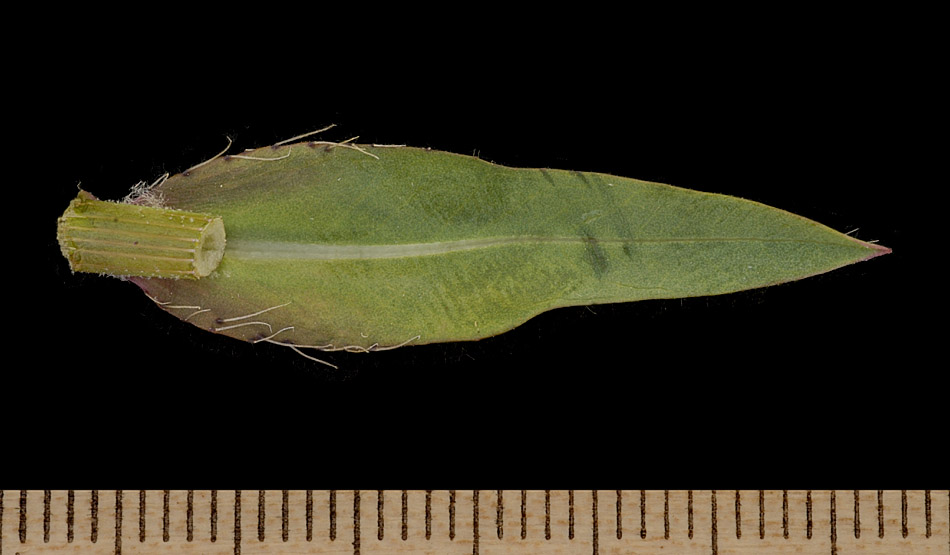
Hieracium piloselloides
 
Tall Hawkweed

Middle Cauline Leaf Top

22 km North, 3 km East of Hudson Bay
14-June-2016

Note the absence of stellate or stipitate-glandular pubescence.  Note also the leaf is not scabrellous.

Piloselloides: Answers to key questions in Flora of North America leading to this species.  The answers are in the order you would normally work through the key. The points I have considered most important and evident in the photographs are in bold.
Corollas yellow (often each with abaxial red stripe) or orange (drying scarlet to purple); cypselae 1?2.5 mm; pappi of 25?40+, white or sordid bristles in 1 series (plants sometimes stoloniferous); NOT [Corollas yellow or ochroleucous to white (pinkish in H. carneum); cypselae (2?) 2.5?7 mm; pappi of (30?) 40?80, white or stramineous to sordid bristles in 1?2+ series (plants not stoloniferous)]
Leaf blades obovate or oblanceolate to spatulate or lanceolate, lengths (2?) 3?8+ times widths; heads usually (2?) 5?30+ in corymbiform to paniculiform or ? umbelliform arrays, rarely borne singly; NOT [Leaf blades elliptic to ? oblanceolate, lengths 2?4 (?6+) times widths; heads usually borne singly]
Corollas yellow (often each with abaxial red stripe); NOT [Corollas orange (drying scarlet to purple)]
Heads (2?) 10?30+, usually in corymbiform to paniculiform, sometimes ? umbelliform, arrays (rarely borne singly in H. triste); NOT  [Heads (1?) 2?5+, in ? umbelliform arrays]
Leaves usually glabrous, sometimes piloso-hirsute (on midribs and at margins) or scabrellous and/or stipitate-glandular (not both piloso-hirsute and stellate-pubescent); corollas 5?9 mm; NOT [Leaves usually piloso-hirsute and stellate-pubescent; corollas 8?12+ mm]
Leaves glabrous or piloso-hirsute (on midribs and at margins); involucres 5?6 (?7) mm; florets (40?) 60?80+; pappi 3?4 mm; NOT [Leaves glabrous or scabrellous and/or stipitate-glandular; involucres (6?) 7?10 mm; florets 20?60+; pappi 4?5 mm]


Hieracium Answers to key questions in Budd's Flora and Flora of Alberta leading to this genus.  The answers are in the normal botanical descriptive order (e.g. roots, stems, leaves, flowers)

perennials with fibrous roots; NOT [annuals or taprooted perennials]

plants with a milky or sticky sap; NOT [sap watery]

NOT [stem diffusely branched; leaves few, cauline, mostly linear or reduced  to scales]

plants with leaves all basal or with a few reduced leaves on the stem; NOT [plants with normal stem leaves] (BF)

plants with at least some cauline leaves, though they may be reduced to bracts; NOT [plants scapose, leaves all basal] (FOA)

leaves glabrous, or if pubescent, not tomentose; NOT [leaves tomentose ciliate] (BF)

lower stem and leaves generally long-hairy; NOT [lower stem and leaves generally glabrous, sometimes puberulent, tomentose or hispid] (FOA)

flower heads several on a flowering stalk; NOT [flower heads solitary on a long stalk]

bracts in series of 1-3; NOT [bracts in a single series, all equal] (BF)

involucre of 2 or more series; NOT [involucre uniseriate or biseriate] (FOA)

bracts with their midribs not thickened

flowers all ligulate (ray); NOT [some or all of the florets tubular]

flowers all perfect;  NOT [ligulate flowers when present pistillate or neuter]

flowers yellow (does not apply to all members of Saskatchewan Hieracium, but does apply to this species)

stamens united to form a tube around the pistil

pappus well developed, at least in part of capillary bristles; NOT [pappus of minute scales or none]

pappus not scale-like at the base, entirely of capillary bristles; NOT [pappus scale-like at the base, with plumose terminal bristles]

pappus-bristles not plumose

achenes not flattened; NOT [achenes flattened, at least twice as wide as thick]