|
juice watery; NOT [juice milky] |
|
leaves appearing before the flowers; NOT
[leaves appearing after the flowers] |
|
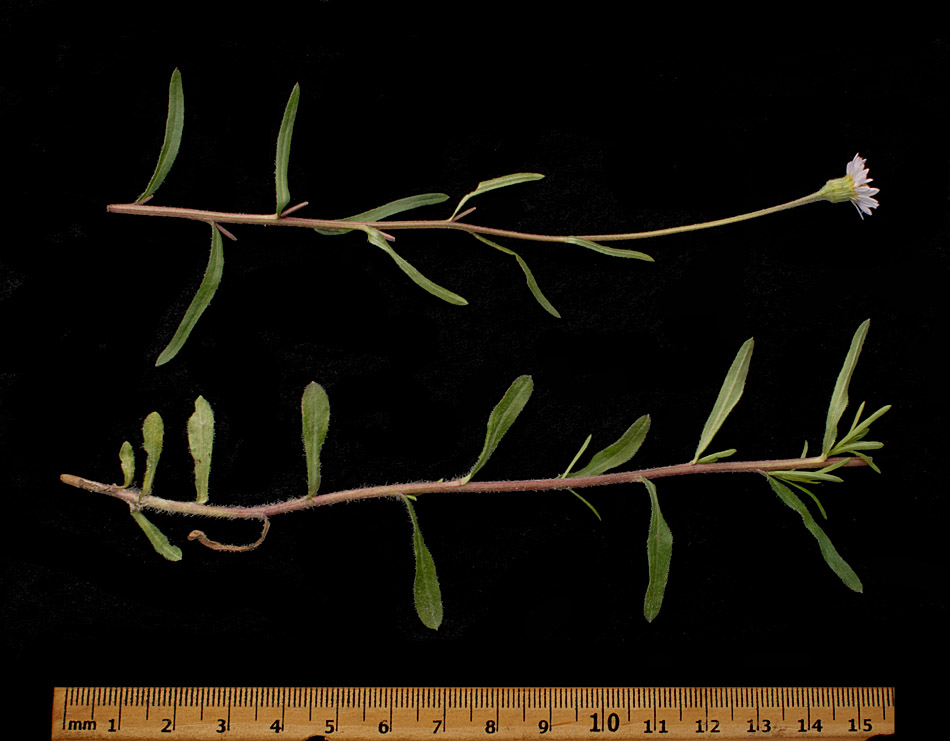
plants usually with leafy stems; NOT
[plants low, stemless, tufted] |
|
basal leaves NOT cordate or sagittate |
|
NOT [basal leaves mostly 1-6 cm long,
linear to oblanceolate or spatulate, forming a dense rosette; plants
with a well-developed taproot; and either densely caespitose, seldom
more than 5 cm tall, the heads sessile among the leaves, or with stout,
simple stems, 5-15 (25) cm tall, heads solitary, involucres 2-4 cm wide,
bracts ciliate to pectinate or fimbriate, rays blue and achenes densely
pubescent, obovate to triangular] |
|
leaves alternate or basal; NOT [leaves
opposite] |
|
leaves not extending beyond flowers; NOT
[leaves usually extending beyond the flowers] |
|
involucral bracts subequal or more or
less imbricate, often green in part, but neither definitely leafy nor
with chartaceous base and herbaceous green tip; NOT [involucral bracts
either subequal and the outer leafy or more commonly evidently
imbricate, with chartaceous base and evident green tip, sometimes
chartaceous throughout] (FOA) |
|
bracts in 1 or 2 series; NOT [bracts in
several series] (BF) |
|
flower heads with both tubular florets
and ray florets (radiate heads) |
|
ligulate florets pistillate or neuter;
NOT [ligulate flowers perfect] |
|
ray florets conspicuous |
|
ray florets 50 or more; NOT [ray florets
10-50] (BF) |
|
rays white, to pink, purple or blue; NOT
[rays yellow or orange] |
|
stamens united to form a tube around the
pistil |
|
style-branches 0.5 mm long or less, or
obsolete; NOT [styles-branches ordinarily more than 0.5 mm long] |
|
style-branches lanceolate or broader; NOT
[style-branches lanceolate or narrower] |
|
style-branches acute to obtuse; NOT
[style-branches acute or acuminate] |
|
pappus composed of numerous hairs; NOT
[pappus absent or composed of a few hairs] (BF) |
|
pappus of capillary bristles, at least in
part; NOT [pappus of 1 or 2 short awns, a mere crown or none] (FOA) |