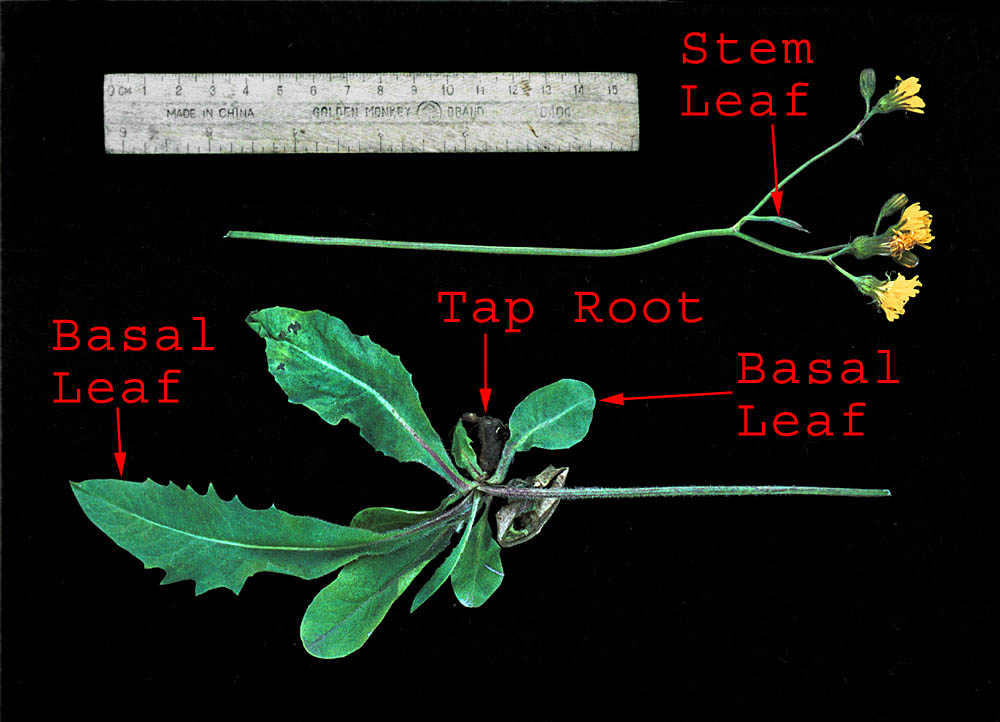
Crepis runcinata


Scapose Hawk's-beard

Whole Plant

Cypress Hills West Block Plateau
07-July-2003

Note that this species is not scapose, although the stem leaves are much reduced.

Note that the key to the species in Budd's Flora requires:

stems or foliage or both pubescent; NOT [stems and foliage glabrous and glaucous]

plants glabrous except for the rosette leaves; NOT [plants lightly to densely pubescent throughout]

Note that the key to the species in Flora of Alberta requires:

stems glabrous; NOT [stems tomentose or puberulent]

basal leaves coarsely hirsute; NOT [basal leaves glabrous]

In fact, the stems can be glabrous or hispid and I have included pictures of both types on this site.  The leaves can be glabrous or hispid to hispidulous, and even glaucous.  See entry for C. runcinata in Flora of North America.

Note that the key to the genera in Budd's Flora requires:

bracts in a single series, all equal; NOT [bracts in series of 1-3] 

This couplet is internally inconsistent, and the first phrase is untrue for this species.  The involucre of C. runcinata is composed of an outer series of unequal bracts up to 3/4 as long as an inner series of equal, elongate bracts.  The corresponding entry in Flora of Alberta is also internally inconsistent:

involucre of 2 or more series; NOT [involucre uniseriate or biseriate] 

The rest of the answers to the key questions are listed below.


Runcinata:  Answers to key questions in Budd's Flora and Flora of Alberta leading to this species.  

plants NOT alpine

plants perennial, with a taproot; NOT [plants annual]

plants 20-70 cm tall with well developed stems; NOT [plants 10-30 cm tall or smaller], NOT [stems 5-10 cm high], NOT [plants 2-6 cm high]

few and smaller stem leaves; NOT [stem with many stalkless leaves]

leaves entire or dentate; NOT [leaves pinnatifid]

cauline leaves, if present, NOT auriculate


Crepis: Answers to key questions in Budd's Flora (BF) and Flora of Alberta (FOA) leading to this genus.  Not all of the following characteristics apply to all members of Crepis found in the Canadian prairies, but they all do apply to this species.

annuals or taprooted perennials; NOT perennials with fibrous roots (FOA)

juice milky; NOT watery (FOA) (BF)

NOT [stem diffusely branched; leaves few, cauline, mostly linear or reduced to scales] (FOA)

plants with at least some cauline leaves, though they may be reduced to bracts; NOT [plant scapose, leaves all basal] (FOA)

plants with leaves all basal or with a few reduced leaves on the stem; NOT [plants with normal stem leaves] (BF)

lower stem and leaves generally glabrous, sometimes puberulent, tomentose or hispid; NOT [lower stem and leaves generally long-hairy] (FOA)

leaves glabrous, or if pubescent, not tomentose; NOT [leaves tomentose ciliate]  (BF)

heads few to many, rarely solitary; NOT [heads solitary] (FOA)

heads several on a flowering stalk; NOT [flower heads solitary on a long stalk] (BF)

bracts with their midribs thickened (BF)

florets all ligulate, no florets tubular (BF) (FOA)

florets  all perfect (FOA)

florets yellow (FOA)

stamens united to form a tube around the pistil (BF)

pappus well developed, at least in part of capillary bristles; NOT [pappus of minute scales or none] (FOA)

pappus NOT scale-like at the base, entirely of capillary bristles; NOT [pappus scale-like at the base, with plumose terminal bristles] (FOA)

pappus hairs simple; NOT plumose] (BF)  (FOA)

achenes NOT flattened; NOT [achenes flattened, at least twice as wide as thick] (FOA)