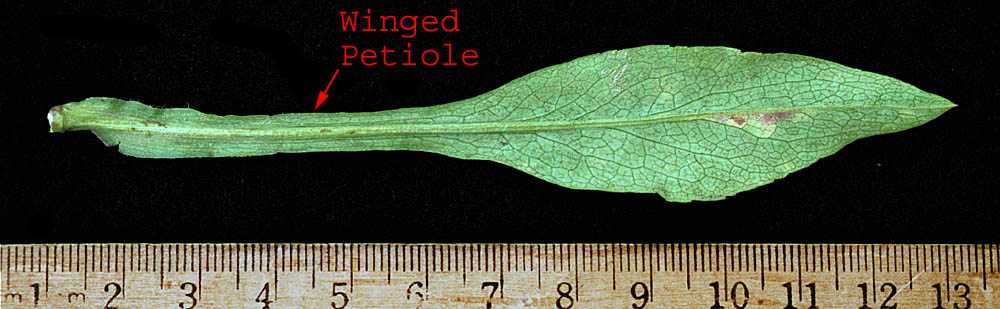
Aster laevis

      
Smooth Aster

Lower Stem Leaf Bottom

5 Miles East of McLean
26-Aug-2005

Note the winged petiole.

The characteristics of the leaves and petioles are important in distinguishing between the Aster species of the Canadian prairies.  The key to the species in Budd's Flora requires the following of A. laevis:

leaves clasping

basal and lower stem leaves sessile or subsessile; NOT [basal and lower stem leaves petioled or narrowed to a petiolar base]

The key to the species in Flora of Alberta requires:

lower leaves linear, lanceolate or oblanceolate, mostly sessile or nearly so; NOT [lower leaves long-petioled, blades ovate to lanceolate, often cordate at base, serrate to serrulate]

lower leaves wing-petioled, the upper auriculate-clasping

In fact, the leaf and petiole characteristics vary depending upon the leaf location.  The basal leaves (if present) and lowest stem leaves are petioled but not cordate.  Further up the stem, the leaves narrow to a winged petiole.  The upper stem leaves are sessile and often auriculate-clasping.  The rest of the key answers are listed below.

Laevis:  Answers to key questions in Budd's Flora and Flora of Alberta leading to this species.  

plants perennial, with rootstocks or root crowns; NOT [plants annual, with fibrous roots]

NOT [plants 50 cm tall, or more; stem stout, usually crimson-purple, hispid; leaves oblong to lanceolate, auriculate-clasping, entire or distantly serrulate]

plants glabrous, except sometimes in the inflorescence; NOT [plants pubescent on the stem and branches in lines decurrent from the leaf bases]

leaves glaucous

involucres and peduncles NOT glandular

heads few to many on a stem; NOT [heads solitary or 1-3 on a stem]

involucral bracts generally herbaceous, at least above, usually not keeled; NOT [involucral bracts chartaceous, keeled, often crimson-edged]

NONE of the outer bracts foliaceous

outer bracts NOT surpassing the inner; NOT [equaling or surpassing the inner]

bracts linear, lanceolate or oblong, all acute; NOT [bracts oblanceolate, the outer obtuse, appressed, well imbricate]

bracts mostly glabrous except the ciliate margins; NOT [bracts densely pubescent]

rays conspicuous

rays mostly more than 15; NOT [rays 8-15, mostly 13, about 2 cm long, white or pinkish]

pappus single; NOT [pappus double, the inner series of long bristles, the outer of bristles about 1 mm long]


Aster: Answers to key questions in Budd's Flora and Flora of Alberta leading to this genus. The answers do not match all species of Aster found in the Canadian prairies, but they do match this species.

taproot absent

juice watery; NOT milky

plants usually with leafy stems; NOT [ plants low, stemless, tufted]

plant is NOT as follows: [basal leaves mostly 1-6 cm long, linear to oblanceolate or spatulate, forming a dense rosette; plants with a well-developed taproot; and either densely caespitose, seldom more than 5 cm tall, the heads sessile among the leaves, or with stout, simple stems, 5-15 (25) cm tall, heads solitary, involucres 2-4 cm wide, bracts ciliate to pectinate or fimbriate, rays blue and achenes densely pubescent, obovate to triangular]

leaves appearing BEFORE the flowers

leaves NOT extending beyond flowers

leaves alternate or basal; NOT opposite

basal leaves NOT cordate, NOT sagittate

involucral bracts either subequal and the outer leafy, or more commonly evidently imbricate, with chartaceous base and evident green tip, sometimes chartaceous throughout; NOT [involucral bracts subequal or more or less imbricate, often green in part, but neither definitely leafy nor with chartaceous base and herbaceous green tip]

bracts in several series; NOT [in 1 or 2 series]

receptacle naked

flower heads with florets both tubular and ray

ligulate flowers pistillate or neuter; NOT perfect

ray florets conspicuous

ray florets 10-50; NOT 50 or more

ray florets usually blue, purple, pink, or white; NOT yellow, NOT orange

stamens united to form a tube around the pistil

style branches ordinarily more than 0.5 mm long; NOT [style branches 0.5 mm long or less, or obsolete]

style branches lanceolate or narrower, acute or acuminate; NOT [style branches lanceolate or broader, acute to obtuse, or obsolete]

pappus of capillary bristles, at least in part; NOT [pappus of 1 or 2 short awns, a mere crown or none] 

pappus composed of numerous hairs; NOT [composed of only a few hairs]