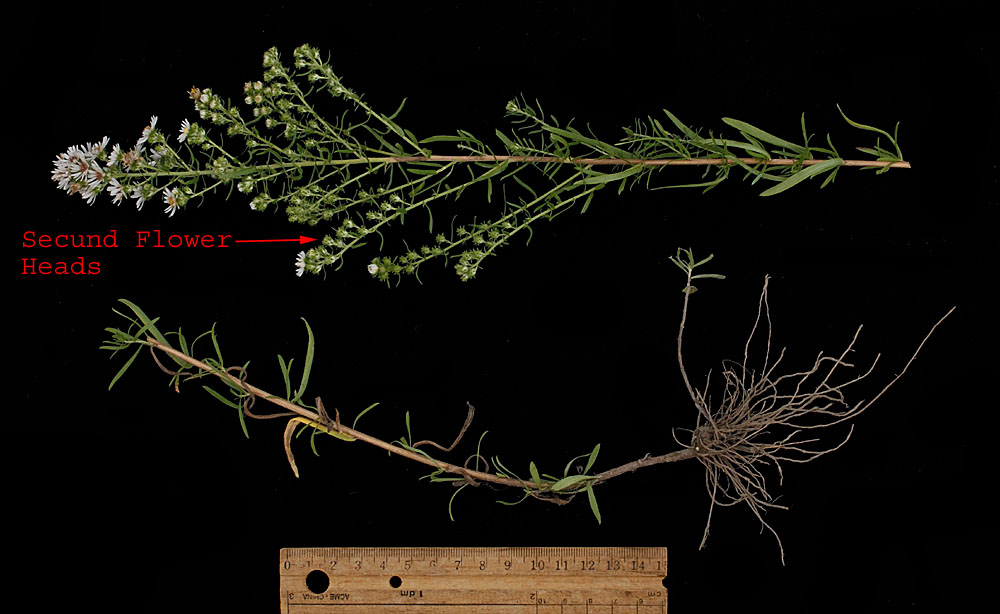
Aster ericoides
 
Many-Flowered Aster

Whole Plant on Velvet

Glenburn Regional Park
06-Aug-2007

A. ericoides is a member of the Multiflori complex.  Associated with this complex are two characters whose states vary independently of each other.  These states have been used to subdivide the complex into species and/or varieties.  Different authors have done this in different manners.  The following tables are a summary of the treatments by Flora of the Great Plains, Flora of North America, Flora of Alberta,  and Budd's Flora.  Note that Flora of North America has split the Aster genus into a number of different genera; the Multiflori complex is part of the Symphyotrichum genus in this scheme.  This web site employs the nomenclature adopted by Budd's Flora.

   Stems Arising Singly,
Colonial with Creeping Rhizomes
Stems Arising in Clusters
Heads Small A. ericoides
S. ericoides var. ericoides
A. pansus
S. ericoides var. pansum
A. ericoides ssp. pansus
Heads Large A. commutatus
S. falcatum var. commutatum
A. falcatus
S. falcatum var. falcatum
A. falcatus ssp. falcatus


   Stems Arising Singly or Stems Arising in Clusters
Heads Small A. ericoides
Heads Large A. falcatus


Ericoides:  Answers to key questions in Budd's Flora and Flora of Alberta leading to this species. 

NOT [plants 50 cm tall, or more; stem stout, usually crimson-purple, hispid; leaves oblong to lanceolate, auriculate-clasping, entire or distantly serrulate]

plant perennial; NOT [plant annual]

plant with rootstocks or root crowns; NOT [plant with fibrous roots]

plants coarse; NOT [plants very slender]

plants more or less pubescent; NOT [plants glabrous, except sometimes in the inflorescence]

plant NOT rough pubescent

leaves and stems more or less densely pubescent; NOT [leaves glabrous, stem pubescent in lines below the leaf bases]

leaves narrowly linear; NOT [leaves broadly linear to linear-lanceolate or lanceolate-ovate]

leaves seldom more than 6-7 mm wide; NOT [ leaves usually more than 10 mm wide]

basal and lower stem leaves sessile or subsessile; NOT [basal and lower stem leaves petioled or narrowed to a petiolar base]

stem leaves sessile or somewhat clasping; NOT [stem leaves auriculate clasping]

leaves NOT silvery silky; NOT [leaves silvery silky on both sides]

heads numerous; NOT [heads solitary or a few at the end of branches], NOT [heads 1-3 on a stem]

heads usually secund on arching branching

heads 10-15 mm across; NOT [heads 20-25 mm across]

involucre and peduncles NOT glandular

involucre 2.5-4.5 mm high; NOT [involucre 5-8 mm high]

bracts strongly imbricate

involucral bracts generally herbaceous, at least above; NOT [involucral bracts chartaceous]

outer bracts NOT foliaceous, not surpassing the inner; NOT [ outer bracts (at least some) foliaceous, equally or surpassing the  inner]

involucral bracts usually NOT keeled

bracts densely pubescent

bracts bristle-tipped

outer bracts 2.0-3.5 mm long; NOT [outer bracts 3-7 mm long)

rays conspicuous; NOT [rays inconspicuous or absent]

rays mostly more than 15; NOT [rays 8-15, mostly 13] (Flora of Alberta)

rays 10-20; NOT [rays 22-35] (Flora of Alberta)

rays mostly less than 6.5 mm long; NOT [rays 7 mm long or longer]

pappus single; NOT [pappus double, with the inner series of firm long bristles, the outer series of bristles about 1 mm long]


Aster: Answers to key questions in Budd's Flora and Flora of Alberta leading to this genus. The answers do not match all species of Aster found in the Canadian prairies, but they do match this species.

taproot absent

juice watery; NOT milky

plants usually with leafy stems; NOT [ plants low, stemless, tufted]

plant is NOT as follows: [basal leaves mostly 1-6 cm long, linear to oblanceolate or spatulate, forming a dense rosette; plants with a well-developed taproot; and either densely caespitose, seldom more than 5 cm tall, the heads sessile among the leaves, or with stout, simple stems, 5-15 (25) cm tall, heads solitary, involucres 2-4 cm wide, bracts ciliate to pectinate or fimbriate, rays blue and achenes densely pubescent, obovate to triangular]

leaves appearing BEFORE the flowers

leaves NOT extending beyond the flowers

leaves alternate or basal; NOT opposite

basal leaves NOT cordate, NOT sagittate

involucral bracts either subequal and the outer leafy, or more commonly evidently imbricate, with chartaceous base and evident green tip, sometimes chartaceous throughout; NOT [involucral bracts subequal or more or less imbricate, often green in part, but neither definitely leafy nor with chartaceous base and herbaceous green tip]

bracts in several series; NOT [in 1 or 2 series]

receptacle naked

flower heads with florets both tubular and ray

ligulate flowers pistillate or neuter; NOT perfect

ray florets conspicuous

ray florets 10-50; NOT 50 or more

ray florets usually blue, purple, pink, or white; NOT yellow, NOT orange

stamens united to form a tube around the pistil

style branches ordinarily more than 0.5 mm long; NOT [style branches 0.5 mm long or less, or obsolete]

style branches lanceolate or narrower, acute or acuminate; NOT [style branches lanceolate or broader, acute to obtuse, or obsolete]

pappus of capillary bristles, at least in part; NOT [pappus of 1 or 2 short awns, a mere crown or none]