|
plants perennial with fibrous roots,
often with rhizomes or stolons, but lacking a taproot; NOT [plants
perennial with taproot, or low spreading annuals] |
|
plants often stoloniferous; NOT [plants
rhizomatous but lacking stolons] |
|
juice watery; NOT [plants with a milky or
sticky sap] |
|
plants more or less white-woolly; NOT
[plants not at all white-woolly] |
|
low plants; NOT [tall plants] |
|
leaves mostly basal, with stem leaves
reduced; NOT [stems leafy] |
|
basal leaves generally forming a
persistent tuft or rosette, stem seldom very leafy; NOT [basal leaves
soon deciduous, not markedly larger than the numerous well-developed
cauline leaves] |
|
basal leaves, if any, not cordate or
sagittate; NOT [basal leaves cordate or sagittate] |
|
receptacle naked; NOT [receptacle densely
bristly] |
|
bracts of involucre dry, parchmenty or
membranous, not green; NOT [bracts of involucre not dry or parchmenty,
usually green] |
|
involucral bracts mostly with dry,
scarious, thin, white to yellowish or brownish tips]; NOT [involucral
bracts not markedly scarious at the tip] |
|
flower heads with all florets tubular |
|
no fertile bisexual florets; NOT [some
florets bisexual] |
|
heads strictly dioecious, the heads
wholly staminate or pistillate; NOT [pistillate heads commonly with a
few central staminate flowers], NOT [heads all with outer pistillate
flowers and central perfect flowers] |
|
male and female florets on separate
plants; NOT [both male and female florets on same plant] |
|
stamens united to form a tube around the
pistil |
|
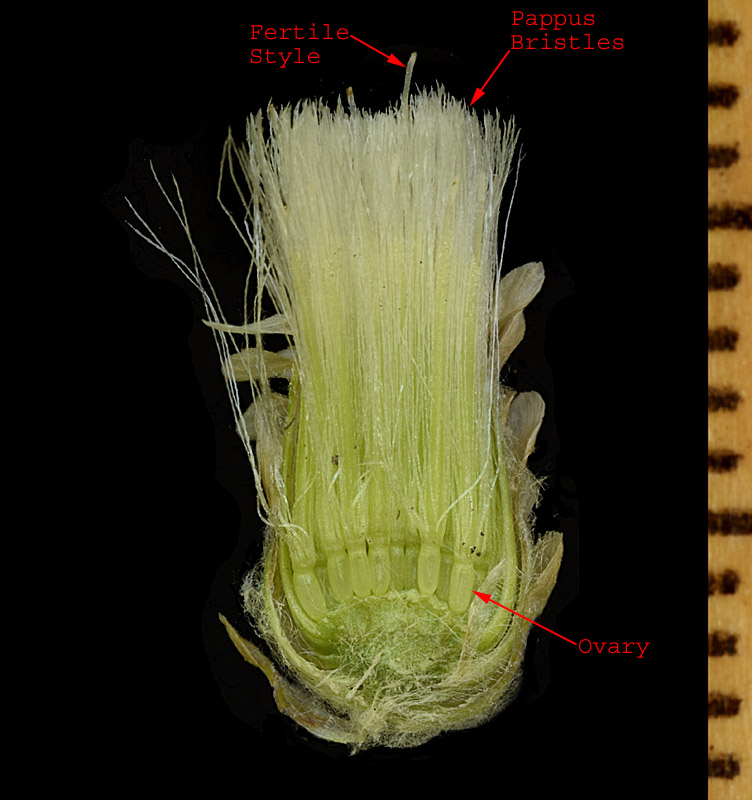
pappus of capillary bristles, sometimes
plumose; NOT [pappus of scales, or of awns, or a crown, or none] |