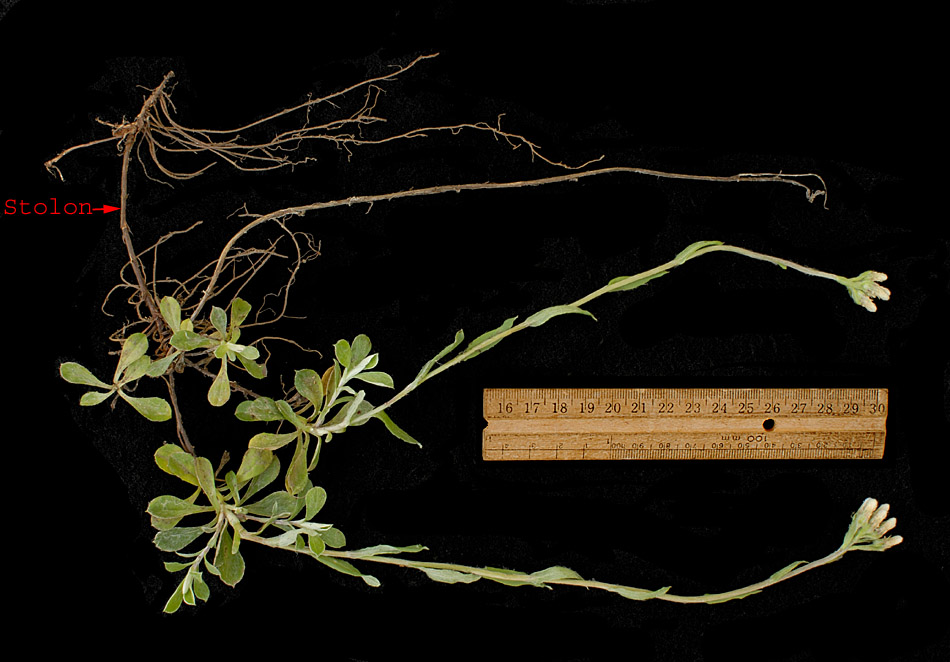
Antennaria neglecta
 
Prairie Everlasting

Two Plants

Centre Block, Cypress Hills Interprovincial Park
14-June-2013

I am following Checklist of the Vascular Plants of Saskatchewan and Flora of Alberta in defining A. neglecta broadly enough to include A. howellii, A. neodioica, and A. russellii.  However, these authors do consider A. corymbosa as a separate species, and I am not completely sure that this specimen is not A. corymbosaA. corymbosa has a dark brown or black spot below the whitish terminal portion of each involucral bract.  Some of the bracts of this specimen have a dark reddish coloration on the margins of the basal green portion.  In the future, I hope to photograph A. corymbosa (which is rare in Saskatchewan) and resolve the ambiguity.

Neglecta: Answers to key questions in Flora of Alberta leading to this species. 

stolons often leafless, with a terminal rosette; NOT [stolons leafy]

basal leaves in well-developed appressed rosettes; NOT [basal leaves, if present, upright around the stem]

plants with reduced stem leaves; NOT [plants with well-developed stem leaves]

main leaves usually ovate to spatulate; NOT [main leaves mostly linear-lanceolate]

basal leaves generally about 1 cm wide; NOT [basal leaves generally narrower]

leaves usually green and glabrous above; NOT [leaves usually greyish and tomentose above and below]

heads in corymbs, often congested; NOT [heads in loose racemes]

heads on short peduncles; NOT [heads on long, slender peduncles]

bracts woolly at base; NOT [bracts glabrous or nearly so]


Antennaria: Answers to key questions in Budd's Flora and Flora of Alberta leading to this genus. 

plants perennial with fibrous roots, often with rhizomes or stolons, but lacking a taproot; NOT [plants perennial with taproot, or low spreading annuals]

plants often stoloniferous; NOT [plants rhizomatous but lacking stolons]

juice watery; NOT [plants with a milky or sticky sap]

plants more or less white-woolly; NOT [plants not at all white-woolly]

low plants; NOT [tall plants]

leaves mostly basal, with stem leaves reduced; NOT [stems leafy]

basal leaves generally forming a persistent tuft or rosette, stem seldom very leafy; NOT [basal leaves soon deciduous, not markedly larger than the numerous well-developed cauline leaves]

basal leaves, if any, not cordate or sagittate; NOT [basal leaves cordate or sagittate]

receptacle naked; NOT [receptacle densely bristly]

bracts of involucre dry, parchmenty or membranous, not green; NOT [bracts of involucre not dry or parchmenty, usually green]

involucral bracts mostly with dry, scarious, thin, white to yellowish or brownish tips]; NOT [involucral bracts not markedly scarious at the tip]

flower heads with all florets tubular

no fertile bisexual florets; NOT [some florets bisexual]

heads strictly dioecious, the heads wholly staminate or pistillate; NOT [pistillate heads commonly with a few central staminate flowers], NOT [heads all with outer pistillate flowers and central perfect flowers]

male and female florets on separate plants; NOT [both male and female florets on same plant]

stamens united to form a tube around the pistil

pappus of capillary bristles, sometimes plumose; NOT [pappus of scales, or of awns, or a crown, or none]