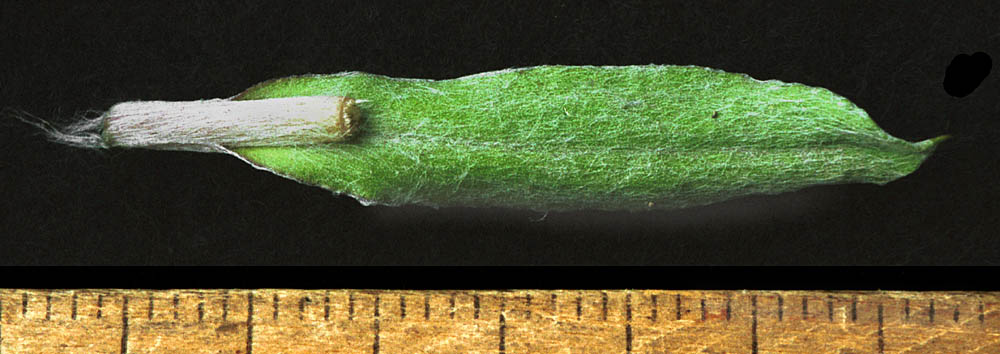
Antennaria howellii

Howell's Everlasting

Stem Leaf Top
Souris River north of Coulter, Manitoba
14-June-2003

Budd's Flora distinguishes this species from A. neodioica according to answers I have labeled as (BF-n).  None of the specimens of A. howellii in the G.F. Ledingham Herbarium have rosette leaves close to 50 mm long, and none have more than one vein clearly evident.  Flora of Alberta includes both A. howellii and A. neodioica in a larger A. neglecta.  I concur with Flora of Alberta; they all should be considered the same species, whatever name is ascribed to them.

The description of the basal leaves in the key answers is somewhat confusing.  The basal leaves are white tomentose below, and green and somewhat pubescent above.  The two surfaces have a noticeably different appearance.  

The stem leaves are reduced, linear, pubescent on both sides, but somewhat more so beneath.

The stolons can have leaves along their entire length, but they do end in a cluster of leaves.

The following are answers to questions in keys from Budd's Flora (BF) and Flora of Alberta (FOA).

Howellii:  Answers to key questions leading to this species.

plants with prostrate leafy stolons, mostly mat-forming; NOT plants with erect offshoots or none (FOA)

stolons usually whip-like, ending in leafy rosettes; stolons NOT leafy throughout (FOA)

[basal] leaves usually small, ovate to spatulate (BF)

leaves broad, commonly green and glabrate on the upper surface; NOT narrower and NOT tomentose on both surfaces (FOA)

leaves glabrous or usually woolly; NOT glabrous on upper surface (FOA)

basal leaves in well-developed appressed rosettes (BF)

rosette leaves at first somewhat pubescent above; NOT glabrous (BF)

rosette leaves glabrous to subglabrous above, densely pubescent below (BF)

rosette leaves clearly 3-5 veined; NOT with only the midrib clearly visible (BF-n)

rosette leaves often to 50 mm long by 30-40 mm wide; NOT smaller than 50 mm long by 40 mm wide (BF-n)

plants with greatly reduced stem leaves (BF)

heads usually short stalked, in corymbs; NOT on slender stalks, NOT in loose racemes (FOA)

heads on short peduncles or subsessile (BF)

inflorescence more or less crowded at the top of the stem (BF)

involucre 7-10 mm high; NOT 5-9 mm high (BF)

bracts woolly at the base (FOA)


Antennaria: Answers to key questions leading to this genus.

juice watery

low plants

plants more or less white-woolly

fibrous-rooted perennials, often with rhizomes or stolons, but without a taproot

stems often stoloniferous

leaves mostly basal, with stem leaves reduced 

basal leaves generally forming a conspicuous, persistent tuft

stems seldom very leafy

none of the leaves cordate or sagittate

involucral bracts dry, thin, scarious, parchmenty or membranous, not green

involucral bracts with white, yellow, or brown tips

receptacle naked

flower heads with all florets tubular (discoid heads)

outer flowers, or all flowers of some heads, pistillate

strictly dioecious (staminate plants rare in some species)

pappus of numerous capillary bristles, sometimes plumose