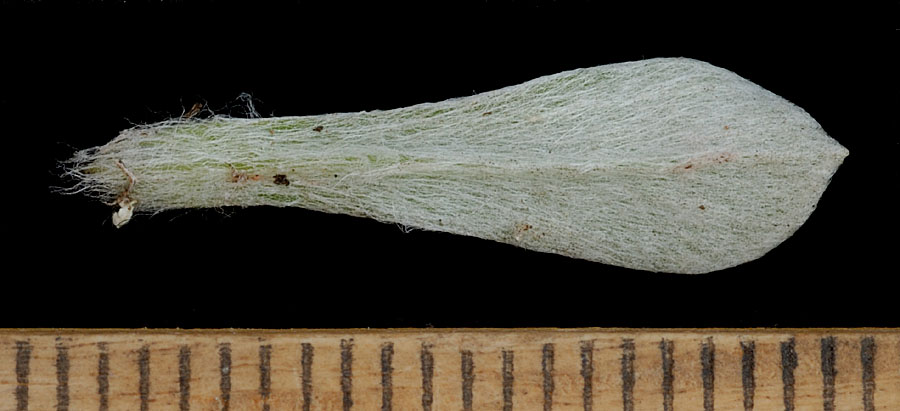
Antennaria aprica
 
Low Everlasting

Basal Leaf Bottom 

Oro Lake Regional Park
09-June-2006

A. aprica is easily confused with A. microphylla.  Therefore, I have included specimens from both species in some of the pictures.  Flora of North America lists A. aprica as a synonym for A. parvifolia.  I have retained the specific epithet aprica because that is what is used in Budd's Flora and Flora of Alberta.  Unfortunately, some floras (including both Budd's Flora and Flora of Alberta) have used parvifolia as the specific epithet for A. microphyllaA. microphylla is related to A. rosea, but is not closely related to A. aprica.  For further discussion, see the entries in Flora of North America.

Aprica: Answers to key questions in Budd's Flora and Flora of Alberta leading to this species. 

stolons leafy; NOT [stolons often leafless, with a terminal rosette]

leaves usually small, ovate, spatulate; NOT [leaves mostly linear-lanceolate]

leaves generally narrower; NOT [leaves generally about 1 cm wide]

leaves usually green and glabrous above; NOT [leaves usually greyish and tomentose above and below]

plants with greatly reduced stem leaves; NOT [plants with well-developed stem leaves]

basal leaves in well-developed appressed rosettes; NOT [basal leaves, if present, upright around the stem]

rosette leaves to 25 mm long; NOT [rosette leaves to 50 mm long]

rosette leaves usually less than 10 mm wide; NOT [rosette leaves 20 mm wide]

lower leaves usually broader; NOT [lower leaves narrowly oblanceolate]

rosette leaves densely pubescent on both sides; NOT [rosette leaves glabrous to subglabrous above; densely pubescent below]

stem leaves 5-7; NOT [ stem leaves 8-12]

heads in corymbs, often congested; NOT [heads in loose racemes]

heads on short peduncles or subsessile; NOT [heads on long, slender peduncles]

involucre 8-13 mm high; NOT [involucre 4-7 mm high]

involucral bracts green or whitish at the base; NOT [involucral bracts with a large dark spot at the base]

bracts woolly at base; NOT [bracts glabrous or nearly so]

bracts with white or cream tips; NOT [bracts with  greenish, light brown, dark brown, or black tips], NOT [bracts with pink tips]  (Flora of Alberta)

terminal part of involucral bracts whitish or light pink when young; NOT [terminal part of involucral bracts roseate to deep pink, even at maturity] (Budd's Flora)


Antennaria: Answers to key questions in Budd's Flora and Flora of Alberta leading to this genus.  

juice watery; NOT milky

plants perennial with fibrous roots, lacking a taproot; NOT [plants perennial with taproot, or low spreading annuals]

plants often stoloniferous; NOT [plants rhizomatous but lacking stolons]

low plants; NOT [tall plants]

plants more or less white-woolly

leaves mostly basal, with stem leaves reduced; NOT [stem leafy]

basal leaves generally forming a persistent tuft or rosette, stem seldom very leafy; NOT [basal leaves soon deciduous, not markedly larger than the numerous well-developed cauline leaves]

basal leaves, if any, NOT cordate or sagittate

bracts of involucre dry, parchmenty or membranous; NOT [green]

involucral bracts mostly with dry, scarious, thin, white to yellowish or brownish tips]; NOT [involucral bracts not markedly scarious at the tip]

receptacle naked; NOT [receptacle densely bristly]

flower heads with all florets tubular

flowers NOT perfect

heads strictly dioecious; NOT [some or all pistillate heads with a few central staminate flowers]

stamens united to form a tube around the pistil

pappus of capillary bristles, sometimes plumose; NOT [pappus of scales, or of awns, or a crown, or none]