False Dandelion
Agoseris glauca
False Dandelion
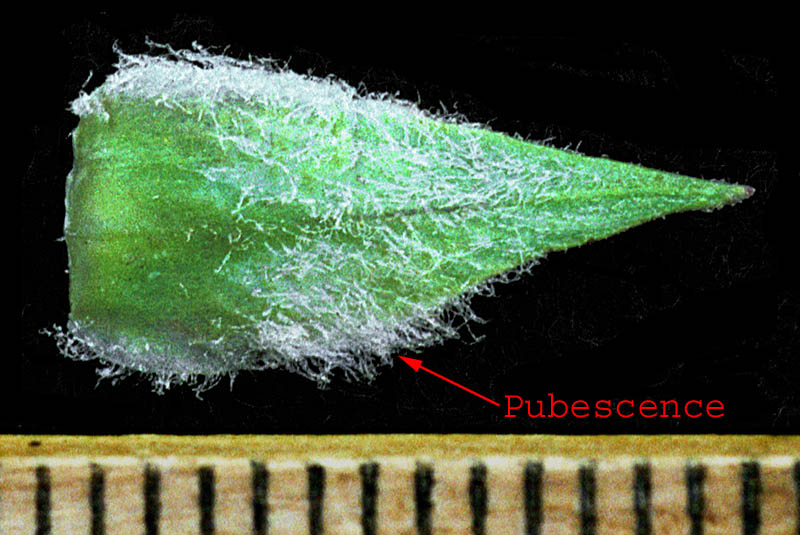
Outer Bract, Outer Side
Outer Bracts Removed to Reveal Inner Bracts
Moosomin Regional Park
23-July-2005
According to The Flora of Canada, this specimen is variety agrestis because:
 | plant is over 2.5 dm tall |
| leaves are glabrous |
| scape is pubescent just below the involucre |
| involucre is pubescent |
According to Budd's Flora and Flora of Alberta, this specimen is variety glauca because:
| leaves are glabrous and more or less glaucous |
| flowers are larger than 3 cm across. |
Flora of the Great Plains notes that there are several cordilleran varieties of A. glauca, but it provides neither key nor descriptions for any varieties on the Great Plains.
Budd's Flora describes another species A. grandiflora. A glauca is distinguished from the latter by observing that the beak of the achene of A. glauca is less than twice as long as the body. The achene beak of A. grandiflora is filiform and 2-4 times as long as the body. Budd's Flora also states that the outer bracts of A. grandiflora are much broader than the inner ones, but the outer bracts of A. glauca are at least somewhat broader than the inner ones. Flora of Alberta and Flora of the Great Plains do not mention A. grandiflora, although The Flora of Canada does.
Note that the key to the genus in Flora of Alberta requires "involucre of 2 or more series; NOT uniseriate; NOT biseriate", which is logically inconsistent. In fact, the involucre of this species consists of more than 2 series of bracts.
| Glauca: Answers to key questions in Budd's Flora and Flora of Alberta leading to this species.
|
| Agoseris: Answers to key questions in Budd's Flora and Flora of Alberta leading to this genus.
|
