Clammyweed
Polanisia dodecatheon
Clammyweed
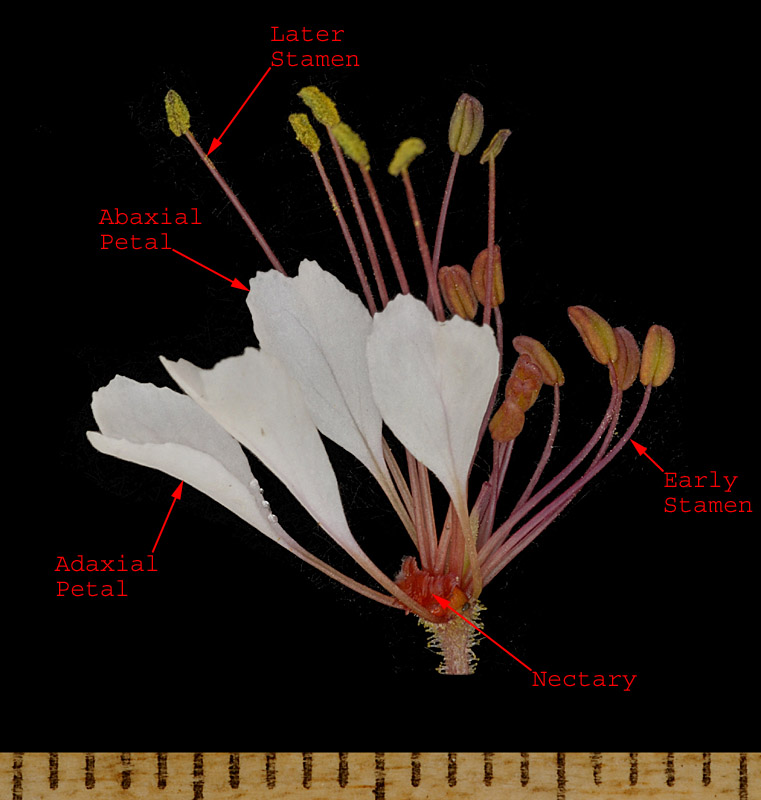
Flower Side, Sepals Removed
Qu'Appelle Valley North of Grenfell
19-July-2017
There are two longer adaxial petals and two shorter abaxial petals. The stamens mature at different times. There is a red/orange nectary on the adaxial side of the flower receptacle.
Budd's Flora and Flora of Alberta place genus Polanisia in family Capparidaceae. However, this genus has been moved to family Cleomaceae in light of more recent research. The Cleomaceae are closely related to the Brassicaceae and diverged from them about 41 million years ago. Polanisia dodecatheon grows in gravelly or sandy soil and sand grains often get trapped on the viscid surface of the plant.
 | Polanisia: Answers to key questions in Budd's Flora and Flora of Alberta leading to this genus.
| ||||||||||||||||||||||||||||
| Capparidaceae: Answers to key questions in Budd's Flora leading to this family.
|
