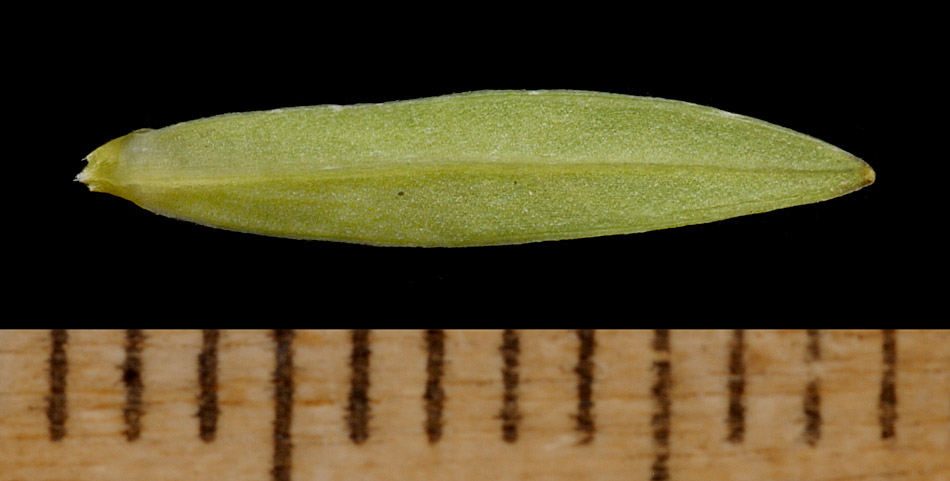
Stellaria crassifolia
 
Fleshy Stitchwort

Upper Leaf Bottom

Greenbush Bog
(20 km West of Town of Hudson Bay on Highway #3)
29-June-2012

Note that the answers to the keys to the species listed below include requirements that the leaves be long and narrow.  These actually apply to just the upper leaves; the lower ones are shorter and broader.

Budd's Flora requires the leaves to be 6-20 mm long, not 2-8 mm long and 2-6 mm wide, not 1-4 mm wide in order to distinguish S. crassifolia from S. humifusa.  The leaves of this specimen don't all closely match this, but in the prairie provinces the only place to find S. humifusa is on sandy beaches along Hudson Bay (the ocean, not the town, in northern Manitoba) so there should be no confusion.

Crassifolia: Answers to key questions in Budd's Flora and Flora of Alberta leading to this species. 

plants perennial; NOT [plants annual]

plant freely branching, often matted; NOT [plant with a few short, erect or ascending stems]

plants glabrous, not glandular-viscid; NOT [plants more or less glandular-hairy and viscid]

basal leaves sessile; NOT [basal leaves petioled, ovate or rhombic-ovate]

leaves linear or elliptic-lanceolate, usually much more than 4 times as long as broad; NOT [leaves ovate-lanceolate, less than 4 times as long as broad]

leaves mostly 6-20 mm long; NOT [leaves mostly 2-8 mm long]

leaves mostly 2-6 mm wide; NOT [leaves mostly 1-4 mm wide]

leaves soft, slightly fleshy; NOT [leaves firm, keeled]

bracts of inflorescence all green, not scarious; NOT [bracts of inflorescence, at least the uppermost, scarious, whitish]

sepals 2-3 mm long; NOT [sepals 3.5-6 mm long]

petals equalling or longer than the sepals; NOT [petals much shorter than the sepals or none]

petals cleft more than halfway, almost to base; NOT [petals cleft less than halfway]


Stellaria: Answers to key questions in Budd's Flora and Flora of Alberta leading to this genus. 

plants NOT with woody base

plants without stipules; NOT [plants with small, ovate, papery, scarious stipules at junction of stem and leaf, and stem and branch]

sepals entirely separate; NOT [sepals united part way, forming a tube]

petals present; NOT [petals absent]

petals lacking claws; NOT [petals clawed]

petals deeply notched or 2-cleft; NOT [petals entire or merely notched at apex]

styles usually 3; NOT [styles usually 5]

ovary NOT stipitate

fruit dehiscent; NOT [fruit indehiscent]

capsule short, ovoid or ellipsoid or oblong; NOT [capsule long, cylindric, often curved]

capsule opening with twice as many valves or teeth as there are styles; NOT [capsule opening with as many entire (or later 2-cleft) valves as there are styles]

capsule usually opening with 6 valves; NOT [capsule usually opening with 10 teeth]

fruit several-seeded; NOT [fruit 1-seeded]


Caryophyllaceae: Answers to key questions in Budd's Flora  leading to this family. 

herbs; NOT [shrubs or trees]

plants terrestrial or semiaquatic; NOT [plants aquatic, leaves submerged or floating]

terrestrial plants; NOT [mud plants with small axillary flowers]

plants NOT with colored milky juice

plants with more than one normal leaf

leaves opposite, whorled, or basal; NOT [some or all leaves alternate]

leaves NOT glandular-dotted

plants without large petal-like bracts; NOT [plants with an involucre of 4 petal-like bracts]

flowers with two floral rings, and with each petal distinct from the others

sepals more than 2; NOT [sepals 2]

stamens NOT united at base; NOT [stamens united at base into 3-5 bundles]

styles 2 or more; NOT [styles single]