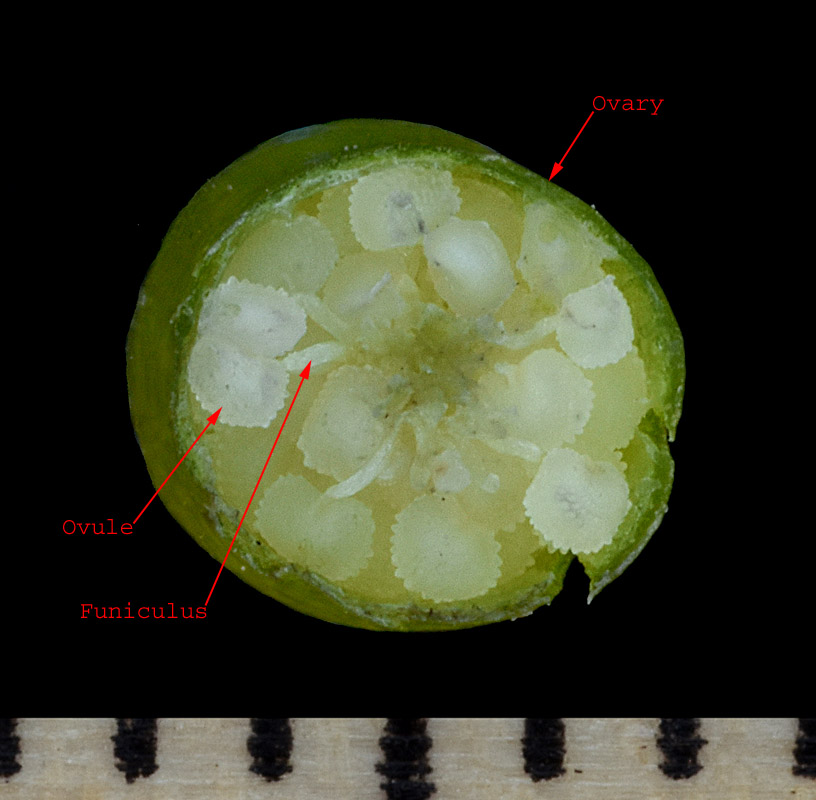
Silene drummondii
 
Drummond's Cockle

Ovary Cross Section

Hudson Bay Regional Park
21-July-2020

In the population sampled here, the petals are about two thirds the length of the capsule and are normally hidden by the calyx tube.  In other populations, the petals are somewhat longer and slightly exserted.  There are ten stamens, five adjacent to the five petals and five opposite to the petals.  The capsule has already opened by five teeth.

Note that Budd's Flora recognized two related genera - Silene and Lychnis - and it called this species Lychnis drummondii.  Today Lychnis is subsumed in a larger Silene. Therefore the answers separating Silene from Lychnis have been removed from the answers leading to the genus and added to the answers leading to the species.

Drummondii: Answers to key questions in Budd's Flora leading to this species.

flowers usually 3 or more; NOT [flowers usually solitary, rarely 2 or 3]

flowers erect on stiffly ascending pedicels; NOT [flowers nodding]

flowers perfect; NOT [flowers of different sexes on separate plants]

calyx not inflated, tightly enclosing the capsule; NOT [calyx somewhat inflated]

calyx not or little enlarging; NOT [calyx enlarging in fruit]

petals included or barely exserted; NOT [petals conspicuously exserted]

styles 5; NOT [styles usually 3]

capsule 1-celled to base; NOT [capsule usually divided into partitions at base]


Silene: Answers to key questions in Budd's Flora and Flora of Alberta leading to this genus. 

plants NOT with woody base

calyx without bracts; NOT [calyx with 1-3 pairs of bracts below]

sepals united part way, forming a tube; NOT [sepals entirely separate]

lobes of sepals NOT over 20 mm long; NOT [sepals with long, leaf-like lobes, over 20 mm long]

petals usually present; NOT [petals absent]

petals clawed; NOT [petals lacking claws]

styles 3-5; NOT [styles2]

styles alternate with the petals; NOT [styles opposite the petals]

ovary stipitate

fruit dehiscent; NOT [fruit indehiscent]

fruit several-seeded; NOT [fruit 1-seeded]


Caryophyllaceae: Answers to key questions in Budd's Flora  leading to this family. 

herbs; NOT [shrubs or trees]

plants terrestrial or semiaquatic; NOT [plants aquatic, leaves submerged or floating]

terrestrial plants; NOT [mud plants with small axillary flowers]

plants NOT with colored milky juice

plants with more than one normal leaf

leaves opposite, whorled, or basal; NOT [some or all leaves alternate]

leaves NOT glandular-dotted

plants without large petal-like bracts; NOT [plants with an involucre of 4 petal-like bracts]

flowers with two floral rings, and with each petal distinct from the others

sepals more than 2; NOT [sepals 2]

stamens NOT united at base; NOT [stamens united at base into 3-5 bundles]

styles 2 or more; NOT [styles single]