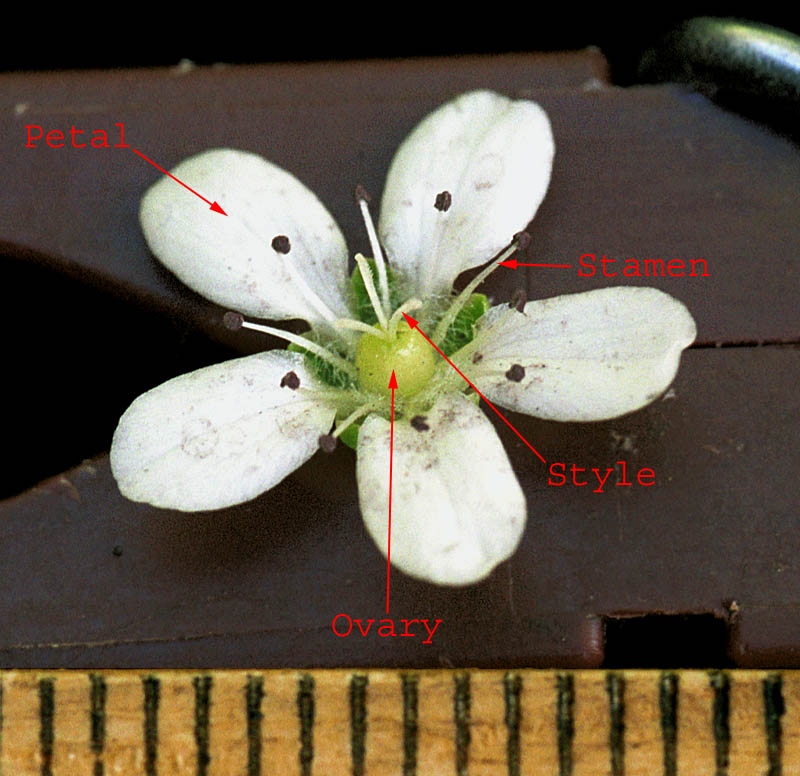
Moehringia lateriflora

 Blunt-leaved Sandwort

Flower Top, Oblique View

Moosomin Regional Park
25-June-2005

This species has been classified as Arenaria lateriflora.  However, many taxonomists place it in a separate genus (Moehringia), partly because its seeds contain a fleshy appendage known as a strophiole.  Ants collect collect the seeds, eat the strophiole, and leave the remainder to germinate.  Budd's Flora treats this species as a member of Arenaria. Flora of Alberta treats it as a member of Moehringia.  Therefore I have included two sets of answers from the keys to the genera: a set leading to Arenaria from Budd's Flora, and a second set leading to Moehringia from Flora of Alberta.  There is only one member of Moehringia described in Flora of Alberta, so the key questions leading to the species are all from Budd's Flora.

Lateriflora:  Answers to key questions in Budd's Flora leading to this species.  

leaves oval to oblong; NOT [linear or filiform]

leaves pubescent below along the midrib; NOT [leaves glabrous below]

bracts of the inflorescence small, scarious; NOT [large, leaf-like]

sepals rounded; NOT acuminate


Arenaria: Answers to key questions in Budd's Flora leading to this genus.  

plants NOT with woody base

plants WITHOUT stipules; NOT [plants with small, ovate, papery stipules at junction of stem and leaf, and stem and branch]

flowers with 5 sepals, 3 styles, and 3 valves; NOT [flowers 5-numerous]

sepals entirely separate; NOT [sepals united part way, forming a tube]

petals entire or merely notched at apex; NOT petals deeply 2-cleft

fruit many-seeded; NOT [fruit with a single seed]

capsule opening with as many entire (or later 2-cleft) valves as there are styles; NOT [capsule opening with twice as many valves or teeth as there are styles]


Moehringia: Answers to key questions in Flora of Alberta leading to this genus.  

leaves WITHOUT stipules; NOT [leaves with scarious stipules]

leaves elliptic to oblong-lanceolate, 1-4 cm long, generally more than 3 mm wide; NOT [leaves narrowly linear-lanceolate or subulate, if ovate to elliptic less than 1 cm long, less than 3 mm wide]

calyx of separate sepals; NOT of united sepals

corolla present

petals LACKING claws

petals entire or emarginate; NOT [petals deeply notched or 2-cleft]

styles 3; NOT [4 or 5]

ovary NOT stipitate

fruit several-seeded; NOT 1-seeded

fruit dehiscent; NOT indehiscent

seeds with a fleshy appendage (strophiole)


Caryophyllaceae: Answers to key questions in Budd's Flora leading to this family.

herbs; NOT [shrubs or trees]

plants terrestrial; NOT [plants aquatic, leaves submerged or floating], NOT [mud plants with small axillary flowers]

plants NOT with colored milky juice

plants with more than one normal leaf

leaves opposite, whorled, or basal; NOT [some or all leaves alternate]

leaves NOT glandular-dotted

plants WITHOUT large petal-like bracts; NOT [plants with an involucre of 4 petal-like bracts]

flowers with two floral rings, and with each petal distinct from the others

sepals more than 2

stamens NOT united at base

styles 2 or more