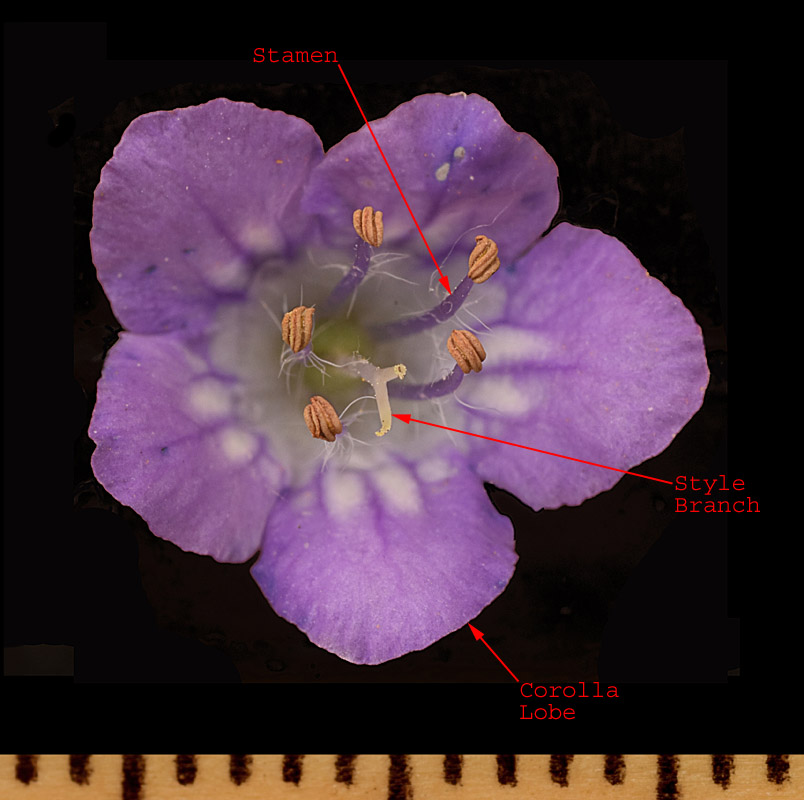
Phacelia franklinii
 
Franklin's Scorpionweed

Flower Top

Hudson Bay Regional Park
17-June-2018

Genus Phacelia has traditionally been included in family HydrophyllaceaeHydrophyllaceae is closely related to Boraginaceae and the two families are now known to be paraphyletic.  The  Angiosperm Phylogeny Group has solved this problem by including all of Hydrophyllaceae inside Boraginaceae.  Other botanists have simply moved Phacelia from Hydrophyllaceae to Boraginaceae, leaving the rest of Hydrophyllaceae intact.

Franklinii: Answers to key questions in Budd's Flora leading to this species. 

leaves deeply lobed to divided; NOT [leaves entire or shallowly dentate]

leaves pinnately divided; NOT [leaves more or less deeply lobed, but not divided]

leaves divided into 7-15 lobes; NOT [leaves divided into 5-9 lobes]

leaf lobes acute; NOT [leaf lobes oblong]

leaf lobes shallowly incised to entire; NOT [leaf lobes deeply incised to pinnatisect]

stamens exserted; NOT [stamens included in the corolla]


Phacelia: Answers to key questions in Budd's Flora leading to this genus. 

leaves pinnately lobed or parted; NOT [leaves palmately lobed]

leaf lobes elongate; NOT [leaf lobes deltoid]

flowers several to many in cymes; NOT [flowers solitary in leaf axils]

flowers in simple or branched scorpioid cymes; NOT [flowers in dense capitate cymes]

style from center of lobes of ovary; NOT [style terminal]

fruit with 4 nutlets; NOT [fruit a capsule]


Boraginaceae: Answers to key questions in Budd's Flora  leading to this family. 

herbs; NOT [shrubs or trees]

plants green or with some chlorophyll; NOT [plants parasitic or saprophytic, without chlorophyll]

plants without milky juice

plants not twining

flowers not in heads or spikes; NOT [flowers in long or short spikes], NOT [flowers in heads or in form resembling a head]

inflorescence usually scorpioid

flowers with two floral rings

petals wholly or partly united forming a tube or bell

corolla regular; NOT [corolla irregular]

stamens 4 or 5; NOT [stamens 8 or 10]

stamens alternating with corolla lobes, or twice their number; NOT [stamens directly in front of corolla lobes]

ovary superior; NOT [ovary inferior]