Asclepias speciosa
 
Showy Milkweed

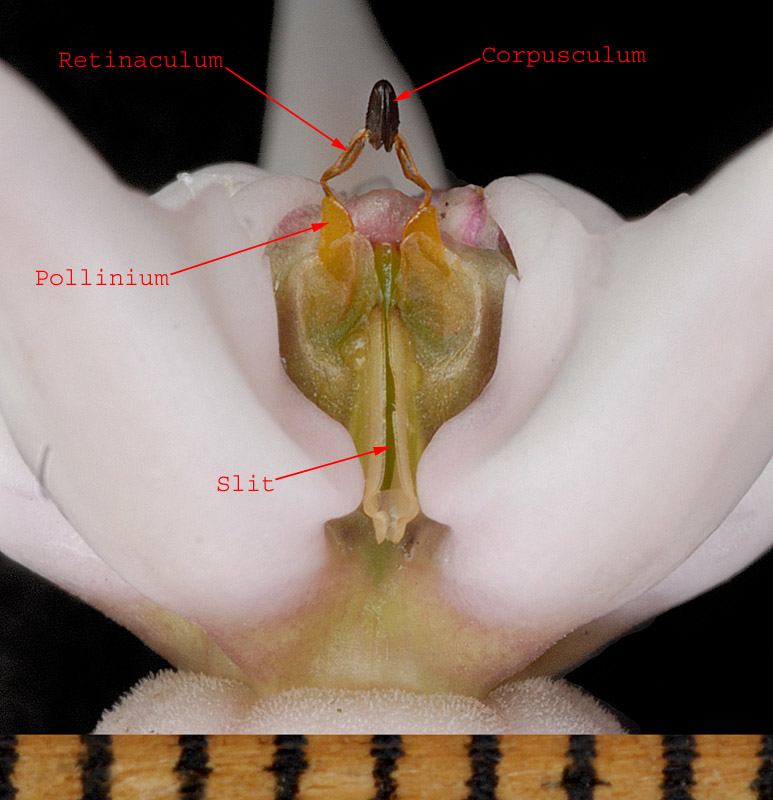
Pollinarium Partially Removed

One Mile West of Melita
16-July-2015

A leg of a pollinating insect will commonly become trapped in the slit between the two anther wings.  As the insect moves upward, the leg will slide up the slit and eventually enter the slit in the corpusculum.  When the insect flies away, it will carry the corpusculum (and two attached pollinia) with it. The corpusculum sits between two adjacent anthers and is attached to one pollinium from each of these two anthers.  The entire structure (corpusculum, pollinia, and connecting arms called retinacula) is called a pollinarium.  The pollinarium has been partially removed from this flower.

Speciosa: Answers to key questions in Budd's Flora and Flora of Alberta leading to this species. 

plants hairy or downy; NOT [plants almost hairless]

leaves opposite; NOT [leaves in whorls]

leaves oblong or oval; NOT [leaves ovate or lanceolate], NOT [leaves linear]

leaves rounded or almost cordate at base; NOT [leaves tapered at base]

flowers purplish or greenish; NOT [flowers rose or red]

hoods of corona long, three times longer than stamens; NOT [hoods of corona short, not much longer than stamens]

hoods of corona lanceolate; NOT [hoods of corona blunt]

corona hoods each with an incurved horn within; NOT [corona hoods without an incurved horn within]

pods with soft tubercles; NOT [pods lacking tubercles]


Asclepiadaceae: Answers to key questions in Budd's Flora leading to this family. 

herbs; NOT [shrubs or trees]

plants green or with some chlorophyll; NOT [plants parasitic or saprophytic, without chlorophyll]

plants with milky juice

flowers not in heads or spikes; NOT [flowers in long or short spikes], NOT [flowers in heads or in form resembling a head]

flowers with two floral rings, but with the petals wholly or partly united forming a tube or bell

corolla regular; NOT [corolla irregular]

stamens united; NOT [stamens distinct]

pollens grains united into a mass; NOT [pollen grains separate]

styles distinct; NOT [styles united]

ovary superior; NOT [ovary inferior]